Designing a Game, Part 3: The Rite of Quellath
So, about scope.
The last post ended with me rolling with it, inside the lines. Then I went and built a dozen games.
Let me explain.
A box of disks
Every version of the game I’d been making kept circling the same things: copied disks, loading screens, made-up companies with their own logos, the Volyx 500. So for a while, that was the game. A made-up console, and a box of strange little games that came with it. Chess against chain-smokers. Poker against English gentlemen. A kart racer. Golf.
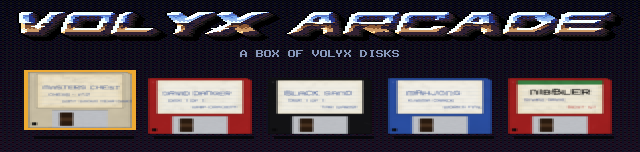
A box of Volyx disks.
It was a lot of fun to make. But one disk in the box kept pulling me back.
The Circle of Quellath
It’s 1986, and it’s a dinner party on Larkspur Court. Somebody’s brought a talking board.

Larkspur Court, November 1986.
You start out pranking the neighbours with the glass. Then the people who died in the house start coming through, and you have to spell out their words from what the neighbours remember. Every wrong letter gets painted across the board in blood, spelling out a name, one letter at a time.
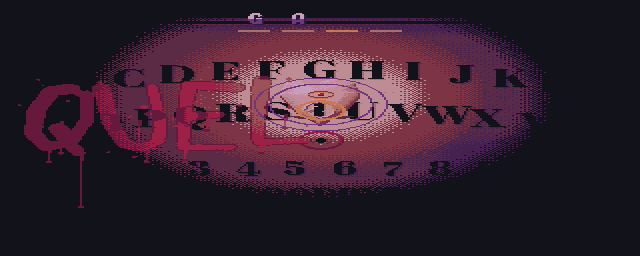
Four wrong. Four to go.
Get eight wrong and the name is finished, and something opens its eye.
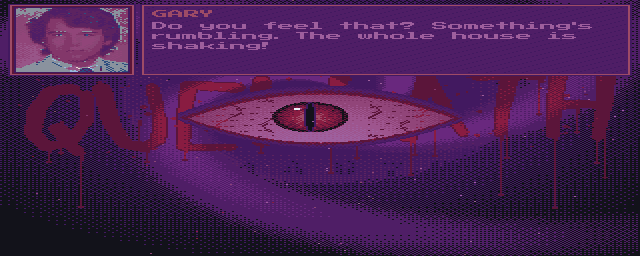
What the hell is that?
I couldn’t stop thinking about that eye. Who is Quellath? Who would want to call it up on purpose? What would they be willing to pay?
That one disk wouldn’t stay small. So I let it out of the box.
The Rite
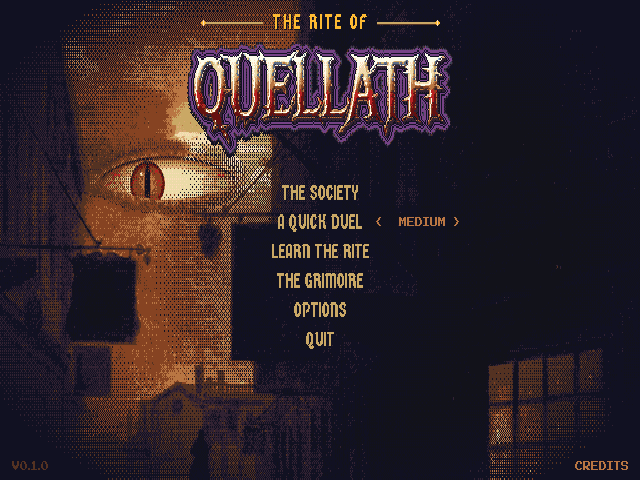
The Rite of Quellath.
London, 1716. There’s a society of gentlemen who meet at night to play an old game of tiles, and the prize is to be seen by Quellath.
The rite is a tug of war. You and the man across the table each build a line of tiles across the board, three tiles a round, and then both lines are chanted. If yours is stronger, Quellath comes nearer. If his is, he drives it back. Pull it all the way in and its eye opens on you, and you win. Let him drive it all the way out, and you lose.
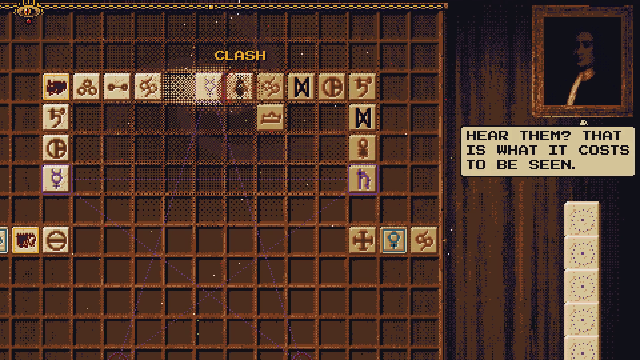
Hear them? That is what it costs to be seen.
Every tile is something old and occult. Gold seals are the names of Quellath, and you know one true name that counts triple. Alchemical signs bind to seals. Planets and star signs leap over whatever’s in the way. Runes chain into litanies. And there’s a red curse that breaks the tile in front of it. When the two lines meet head on, they clash, and the weaker line loses its last two tiles.
Underneath, it’s a numbers game. On top, it’s chanting, voices, and a room that starts to come apart as Quellath gets close.
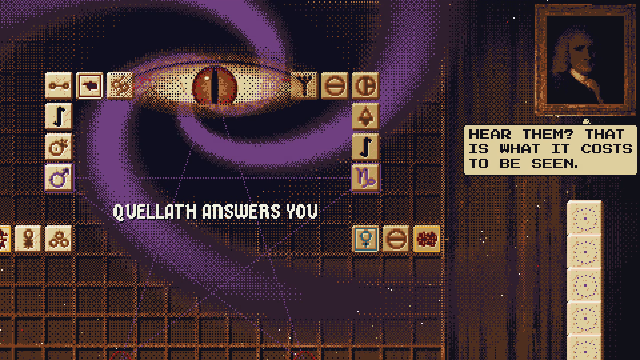
Quellath answers you.
The Society
You climb the Society of Quellath, a ladder of six men, each one met on a night when the sky over London goes wrong. One night it’s a red aurora. Another, a blood moon. The stars go out. On the last night, something falls out of the sky and the city burns.
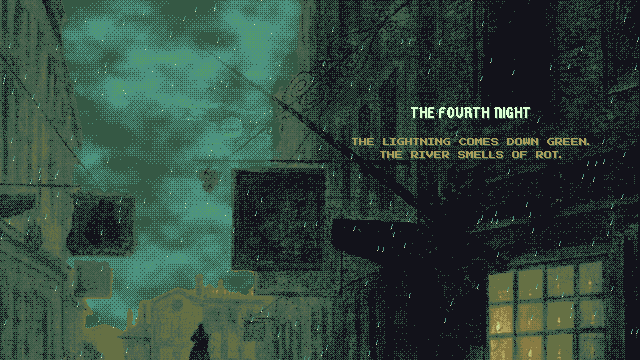
The lightning comes down green. The river smells of rot.
Between the six there are members of the Society to get through, and every night they play a little sharper than the last.
Between nights, the house’s butler, Nethercott, reads your cards. They’re from a real seventeenth-century tarot deck, rotting at the edges, all face down. The one you turn is yours, for better or worse.
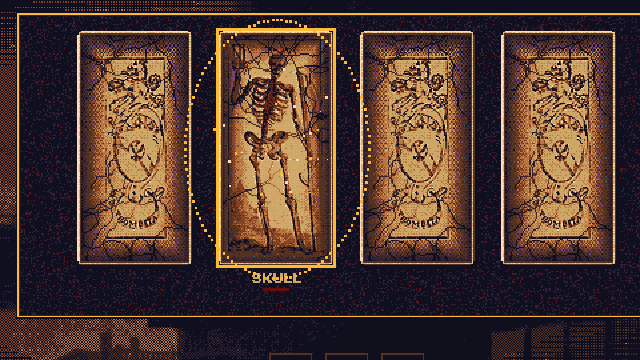
The reading.
You also carry a grimoire, a forbidden book that bends the rules of the rite. Each one changes how you play.
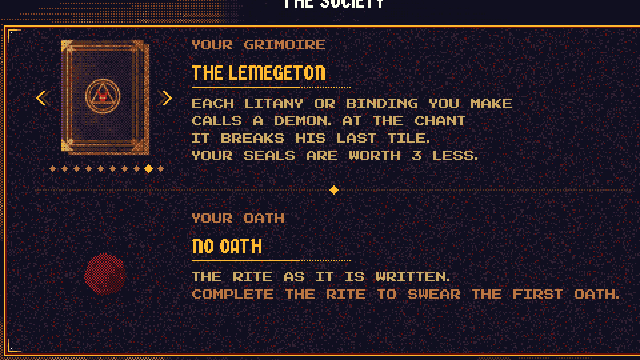
The Lemegeton.
And if you lose to one of the six, he takes something from you, and you don’t get it back.
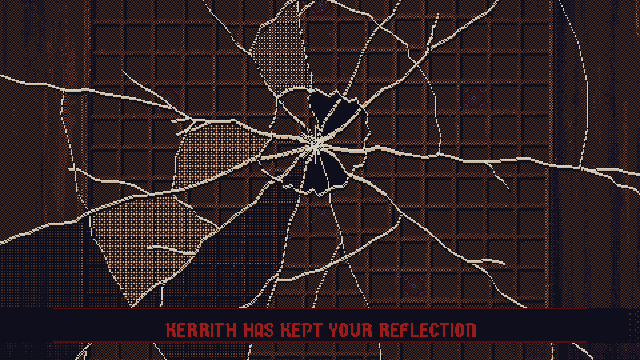
Kerrith has kept your reflection.
How it’s made
Almost everything you see started as public-domain art: Hogarth’s London, old engravings, society portraits, a painting of the Great Fire, that tarot deck. All of it is run through my own filters until it looks like it was always an Amiga game. The music and sounds go through a little Amiga tracker I built, which crunches everything down to 8 bits, the same way the old machines did. That crunch is half the mood.
It runs on the same foundations as everything else I’ve been building: the Volyx’s screen and lettering, and VolythEngine’s sound.
Inside the lines, for real this time
I kept saying I was rolling with it, inside the lines. I don’t think I really was until now. A dozen games is a dozen games to finish. This is one game, with a beginning, an end, and a demo.
The demo is coming to Steam soon: the tutorial, the grimoire, and your first three nights, ending with the first of the six. I’ll post the link here when it’s up.
When I wrote about the scene, I talked about a box of copied disks I didn’t understand as a kid. I built that box. Then I found the one disk in it I couldn’t stop playing.